
Artificial Sweeteners in Nicotine Pouches: What to Know
Artificial sweeteners have been in the news following a 2025 study on sweetener intake and cognitive decline. Because some nicotine pouches also contain sweeteners, it is reasonable to wonder how the amounts compare.
This article explains what the study found, which sweeteners may be used in nicotine pouches, and how measured pouch levels compare with sweetener intake from foods and drinks.
- Artificial sweeteners are common ingredients in many foods, beverages, and nicotine pouches.
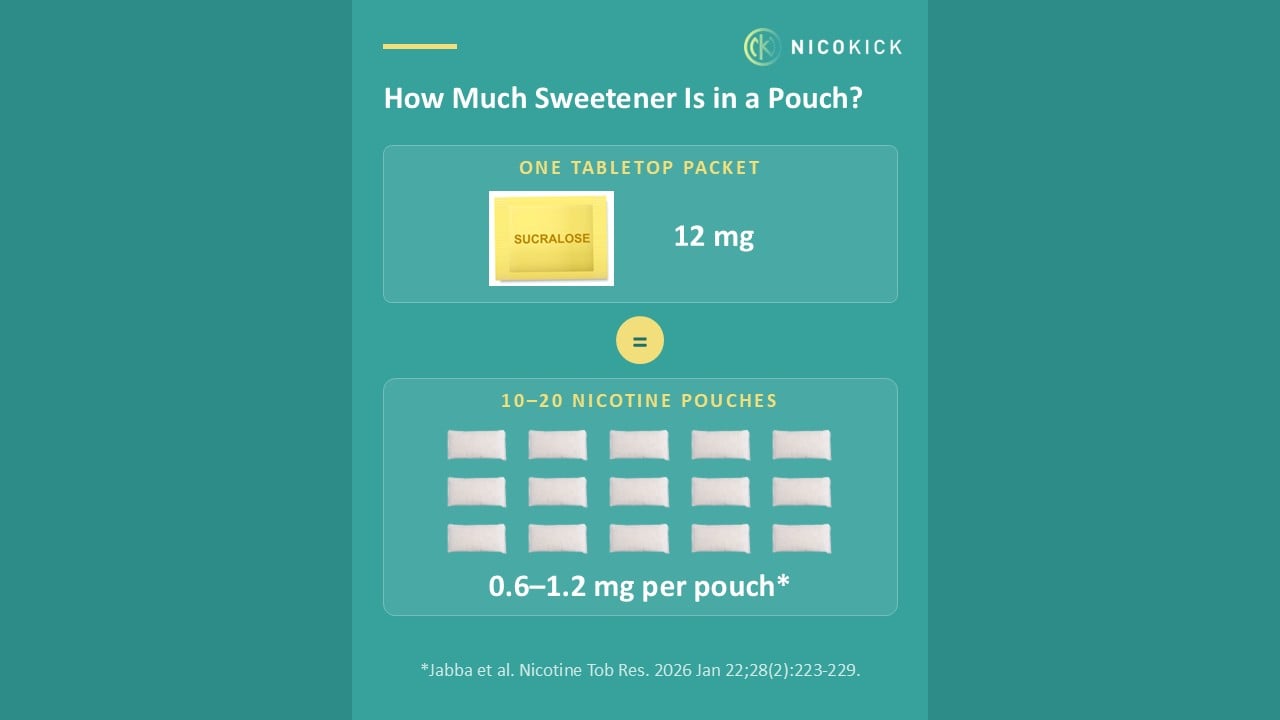
- One study reported that a pouch may contain 1-2 mg of artificial sweetener.
- Those per-pouch amounts are low compared with typical exposure from foods and beverages.
What Recent Research Says About Sweeteners
Researchers at the University of São Paulo followed nearly 12,800 Brazilian adults for 8 years and looked at artificial sweetener intake and changes in memory, language, and processing-speed test scores.
Participants were divided into three groups by average daily sweetener intake:
- Low group: around 20 mg per day
- Middle group: around 66 mg per day
- Highest group: around 191 mg per day
The highest-intake group showed cognitive decline 62% faster than the lowest-intake group during the study period. The authors described this difference as equivalent to about 1.6 years of additional brain aging over the study period.
Six sweeteners were linked with faster decline in the Brazilian study: aspartame, acesulfame potassium (ace-k), saccharin, erythritol, xylitol, and sorbitol. Tagatose was not associated with decline, and sucralose was not among the sweeteners measured.
It is important to note that this was an observational study, which means that it can identify associations but does not prove that sweeteners caused the observed changes.
Which Sweeteners Are Used in Nicotine Pouches?
Nicotine pouch ingredients vary by manufacturer and market.
Across markets, sweeteners in nicotine pouches may include ace-K, sucralose, xylitol, maltitol, erythritol, aspartame, saccharin, and sorbitol.
Ace-K and sucralose are two of the most consistently used sweeteners across the category, but only one study has measured levels in three US brands.
| Sweetener | In the 2025 cognition study? | In nicotine pouches?* |
| Acesulfame potassium (Ace-K) | Yes | Measured as ~0.3–0.9 mg/pouch |
| Sucralose | No | Measured as ~0.6–1.2 mg/pouch |
| Xylitol | Yes | Observed on ingredient lists; no product-level amounts reported |
| Maltitol | No | Observed on ingredient lists; no product-level amounts reported |
| Erythritol | Yes | Observed on ingredient lists; no product-level amounts reported |
| Aspartame | Yes | Not observed on ingredient lists |
| Saccharin | Yes | Not observed on ingredient lists |
| Sorbitol | Yes | Observed on ingredient lists; no product-level amounts reported |
| Stevia | No | Observed on ingredient lists; no product-level amounts reported |
*Note: Ace-K and sucralose levels from a 2026 study of US products. A 2023 analysis of European products shows that other sweeteners are listed pouch ingredients, but the levels were not measured.
How Do Pouch Sweetener Levels Compare?
Using the per-pouch range measured for US products, daily exposure to ace-K and sucralose from nicotine pouches corresponds to the lowest intake levels reported in the 2025 cognition study.
| Comparison | Estimated sweetener intake* |
| Lowest-intake group in the 2025 study | ~20 mg/day |
| Middle-intake group in the 2025 study | ~66 mg/day |
| Highest-intake group in the 2025 study | ~191 mg/day |
| 5 pouches/day, using ace-K range measured in pouches | ~1.5–4.5 mg/day |
| 20 pouches/day, using ace-K range measured in pouches | ~6.0–18.0 mg/day |
| 5 pouches/day, using sucralose range measured in pouches | ~3–6 mg/day |
| 20 pouches/day, using sucralose range measured in pouches | ~12–24 mg/day |
*Note: Ace-K and sucralose levels from a 2026 study of US products.
How Does This Stack Up to Other Products?
A 2023 German study measured sweetener concentrations in 92 market-relevant low- or no-sugar soft drinks. The table below converts those reported concentrations from mg/L to approximate mg per 12 fl oz can.
| Sweetener | Measured concentration in soft drinks* | Amount per 12oz can | Measured concentration in nicotine pouches* |
| Ace-K | 5–365 mg/L | ~2–130 mg | ~0.3–0.9 mg/pouch |
| Aspartame | <1–492 mg/L | <1–175 mg | Not measured |
| Saccharin | <1–68 mg/L | <1–24 mg | Not measured |
| Sucralose | 2–127 mg/L | ~1–45 mg | ~0.6–1.2 mg/pouch |
| Steviol glycosides | <1–38 mg/L | <1–13 mg | Not measured |
*Note: Ace-K and sucralose levels from a 2026 study of US products. Soft drink values come from German low- and no-sugar soft drinks tested in the MEAL Study. Per-can values are approximate and are based on 12 oz. These comparisons address sweetener quantity only and do not compare the overall risks of foods, beverages, or nicotine products.
How Are Sweetener Limits Set in Food Products?
Sweetener limits are based on safety assessments of how much of a substance people can consume over time. For high-intensity sweeteners used in foods, the U.S. Food and Drug Administration (FDA) either approves the sweetener as a food additive or recognizes that its intended use is generally recognized as safe. In both cases, the safety question is whether there is a reasonable certainty of no harm under the intended conditions of use.
When FDA approves a food additive, it reviews the available scientific evidence and sets conditions for how the ingredient may be used. For many high-intensity sweeteners, FDA also provides an acceptable daily intake, or ADI. The ADI is an exposure benchmark, expressed in milligrams per kilogram of body weight per day, that is considered safe to consume every day over a lifetime.
GRAS stands for “Generally Recognized as Safe.” A GRAS conclusion means qualified experts have determined, using publicly available scientific evidence or a long history of food use, that the substance is safe for its intended use in food. GRAS is not the same as having no limit; it still depends on the ingredient, the amount used, and the intended conditions of use.
| Sweetener | FDA regulatory status for food use* | FDA ADI | Illustrative daily amount for a 60-kg adult* |
| Ace-K | Approved high-intensity sweetener | 15 mg/kg body weight/day | 900 mg/day |
| Aspartame | Approved high-intensity sweetener | 50 mg/kg body weight/day | 3,000 mg/day |
| Saccharin | Approved high-intensity sweetener | 15 mg/kg body weight/day | 900 mg/day |
| Sucralose | Approved high-intensity sweetener | 5 mg/kg body weight/day | 300 mg/day |
| Steviol glycosides | Some are GRAS for specified food uses | 4 mg/kg body weight/day | 240 mg/day |
| Xylitol, erythritol, sorbitol, maltitol and other sugar alcohols | Used as sugar alcohols in foods; labeling rules address sugar alcohol declaration and warnings for some polyols | No single ADI listed | Not applicable |
*Note: See https://www.fda.gov/food/food-additives-petitions/aspartame-and-other-sweeteners-food Calculated for a 60-kg (132-lb) adult.
How to Check Which Sweeteners Are in a Nicotine Pouch
Sweetener formulations are not identical across nicotine pouch brands, flavors, or product lines. To know which sweetener a specific pouch contains, check the product’s ingredient list.
Do All Nicotine Pouches Contain Artificial Sweeteners?
No. Artificial sweeteners are used in some nicotine pouch formulations, but they are not universal across the category. Ingredients vary between brands and products, and some nicotine pouches may be made without artificial sweeteners.
FAQs
- Many nicotine pouches contain sweeteners, although the type and amount vary by product and manufacturer. Acesulfame potassium (ace-K) and sucralose are commonly used across the category, while some formulations use xylitol, maltitol, or erythritol.
- The term “unflavored” refers to the lack of a characteristic flavor like mint or fruit. Some unflavored pouches may contain sweeteners.
- There is no single amount that applies to every nicotine pouch. In the study discussed above, ace-K was measured at approximately 0.3–0.9 mg per pouch across the three brands tested. In the product containing sucralose, researchers measured approximately 0.6–1.2 mg per pouch. Other brands and formulations may differ.
- No. Nicoleaks does not currently include sweetener measurements. Our testing focuses on other product characteristics and analytes selected for product transparency and quality assessment.
Important:
The products sold on this site contain nicotine. Nicotine is an addictive chemical that may increase heart rate and blood pressure and pose risks for individuals with certain medical conditions, particularly cardiovascular disease. These products are intended only for adult (21+) current nicotine users and are not for non-users. Sales to persons under 21 are prohibited.