


What is a "Swedish Lip Rocket?" Smokeless Slang Explained
“Swedish lip rocket” is the latest way to jokingly refer to a nicotine pouch or snus that’s popped up online.
We've seen it emerging as a trend among pouch users to connect over their experiences and share content that might otherwise not be allowed on social media. As a relatively new expression, it hasn't gotten the same sort of traction as “upper decky” or “lip pillow” (yet), but keep in mind that these phrases have been doing the rounds on TikTok, Reddit, and Instagram for a while now.
Here at Nicokick, we figure the more you know the better when it comes to anything nicotine-related, so we decided to take a closer look at the term to see what we can learn from it so far.
Key Takeaways
- “Swedish lip rocket” is a funny way of referring to nicotine pouches and snus that’s emerged recently on social media.
- If we break the phrase down, it references the Scandinavian heritage of these smokeless products (from Sweden); the placement of these pouches (under your lip); and the way they “launch” nicotine into your system (like a rocket).
- It was most likely popularized as a way of talking about smokeless tobacco/nicotine without mentioning the products explicitly, since this goes against the user guidelines of certain platforms like TikTok.
- It’s not an industry term. Think of it as insider lingo that’s used informally online.
- You could say "Swedish lip rocket" is still quite niche, and you’re more likely to find slang terms like “upper decky” and “lip pillow” being used in the context of nicotine pouches.
Let's Breakdown the Terminology
At first, the phrase might sound odd. But once broken down into its 3 main components, the meaning of “Swedish lip rocket” becomes clearer.
This is a nod to the Scandinavian origins of these products.
Snus has a long history in Sweden if you count the loose-leaf tobacco variety that dates back to the 16th century before pre-portioned pouches were introduced in the 1970s.
Fast forward to the early 2000s and nicotine pouches are the latest tobacco leaf-free innovation that adult users can thank Sweden for. They were invented as we learnt more about the dangers of combustible tobacco, and methods were developed to extract nicotine from tobacco leaves. In recent years, you could say they’ve come to define modern nicotine consumption.This obviously refers to the placement of a snus or nicotine pouch under your lip, against your gum. “Parking" a pouch could feel a bit strange in the beginning for anyone who’s used to actively inhaling their nicotine rather than passively absorbing it in their mouth.
Most people prefer to use their top lip, saying that the pouch sits more comfortably there and feels more secure during conversation. It’s also said to produce less saliva—no matter if it sits on the left or right side.
Former users of other smokeless formats like dip and chew, however, may be more familiar with using their bottom lip. Whichever you choose is a matter of personal preference.This is a playful way of describing how snus and nicotine pouches “launch” nicotine into your system.
Most pouches start releasing their active ingredient within a few minutes, which may cause some tingling but is generally nothing to be worried about. This is followed by 10-30 minutes of the nicotine level in your blood rising to a peak, which can increase your focus and sense of alertness. Then an extra 20-30 minutes as the nicotine and flavor gradually fades.
Of course, the exact timings will vary from brand to brand and person to person. We do know that higher strength pouches or those with more moisture content are typically faster-acting though.
Suspected Origins
You’d be right in assuming that “Swedish lip rocket” is not an official industry term. It has emerged online as informal insider lingo—similar to “upper deckies” and “lip pillows,” which you might have heard before.
The term started getting attention on social media earlier this year as people wanted to discuss aspects of their experience using nicotine pouches and snus, without mentioning them explicitly.
This could be because platforms like TikTok are quite strict when it comes to showing or promoting controlled substances like nicotine and tobacco, and people don’t want to risk their posts being taken down for violating these rules.
It could also be that users just think "Swedish lip rocket” is a fun way of referring to their favorite pouches. And hey, that’s ok too.
Usage of the Term
It’s not unusual for slang like “Swedish lip rocket” to circulate in niche online interest groups or spread via hashtags on social media. Users who find the post amusing or relatable will like it, share it, and maybe even upload their own.
Most of the “Swedish lip rocket” content that we’ve come across references the nicotine release of a pouch. Sticking with the analogy, this can be likened to a rocket’s “take off" or, in extreme cases, the dizzying rush of a pouch that’s too strong.
Other Popular Terms
Here you can see how the organic searches for “Swedish lip rocket” compare to other slang for smokeless products over the past 2 years.
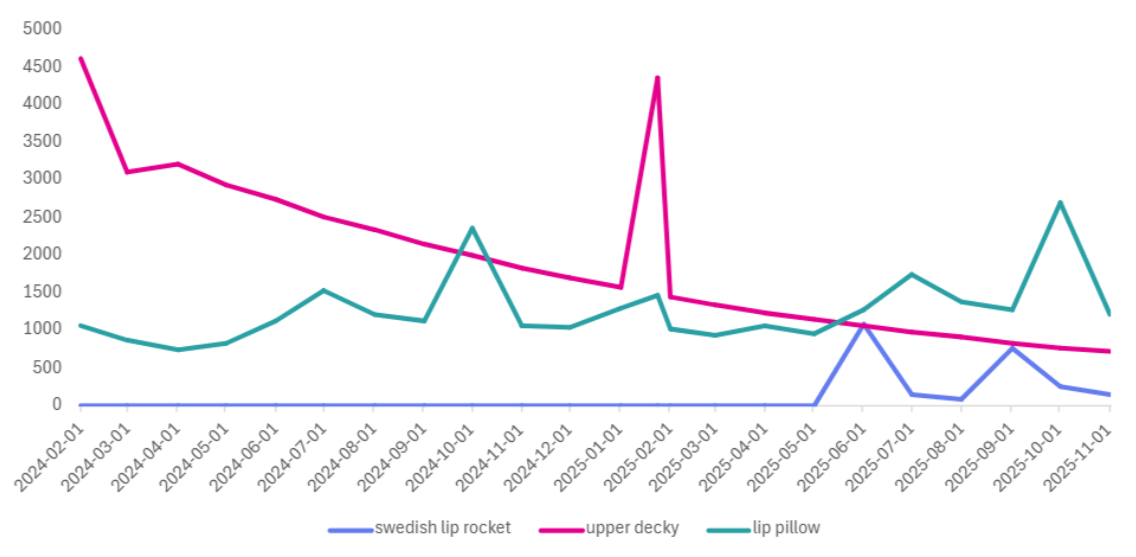
It’s clear that at its peak in 2024, “upper decky” was the go-to term for people in-the-know. It’s now on a downwards trend with the exception of a sharp spike in January, 2025, but this dip does not necessarily reflect a drop in usage. It could be explained by users feeling more familiar with the term and simply searching for it less.
“Lip pillow” has maintained moderate interest and seems to be the most consistently searched for term of the last 2 years, whereas “Swedish lip rocket” has only just appeared on the smokeless scene. It may not have received the same sort of attention yet, but all it takes is for one post to go viral before it hits the mainstream.
Where to From Here?
As the US market matures and more adult nicotine users shift towards smokeless alternatives—especially nicotine pouches—it’s clear that it’s not just the conversation that will be worth watching, but how the language we use to describe this category evolves over time.
We're interested to see which expressions are adopted, adapted, or ultimately abandoned, driven by real user experiences and the constraints of the platforms we use to talk about them.