

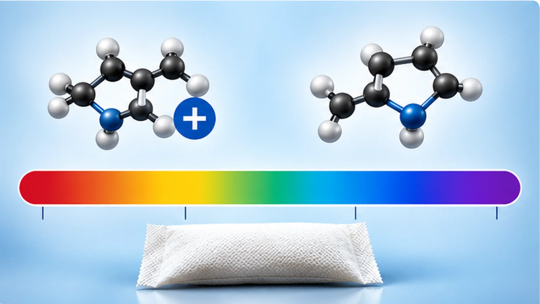
Part 3 - Freebase Nicotine Explained: The Role of pH
The pH of a pouch helps determine nicotine’s chemical form. That matters for absorption, but it does not explain every step of delivery.
Part 2 explained how nicotine becomes available from its formulation. Part 3 takes a look at a 2026 review to explain freebase nicotine: what the term means, how pH affects it, and why the freebase percentage is not the same as the amount absorbed by the body.
What Is Freebase Nicotine?
Freebase nicotine is nicotine in its electrically uncharged form. When an extra hydrogen ion is attached, nicotine carries a positive charge and is called protonated, or ionized, nicotine. In the pH range relevant to pouches, nicotine can change between these two forms as its surroundings change.
Both forms are nicotine. “Freebase” describes its chemical state—not whether it comes from tobacco or was made synthetically. It is also distinct from the nicotine salt or resin used to incorporate nicotine into a product, as discussed in Part 2.
Why Does Nicotine's Chemical Form Matter?
After release from the pouch, nicotine must cross the lining of the mouth to enter the bloodstream. The electrically neutral freebase form generally crosses the cell membranes in that lining more readily than the positively charged form. This is why researchers consider the balance between the two forms when studying absorption.
That does not mean protonated nicotine cannot be absorbed. Charged nicotine can be transported into the blood through other pathways. The distinction concerns how readily nicotine crosses the barrier, not a simple division between nicotine that is absorbed and nicotine that is not.
What Does pH Measure?
pH describes how acidic or alkaline a solution is. A pH of 7 is neutral; lower values are acidic and higher values are alkaline, or basic. The scale reflects hydrogen ion activity: a one-unit decrease means roughly ten times greater activity. This matters because hydrogen ions can attach to nicotine and change its electrical charge.

How does pH Change The Balance?
Lower pH favors protonated nicotine; higher pH favors freebase nicotine. This changes the proportion in each form, not the total amount of nicotine present.
How much of each form is present depends on both pH and a chemical property of nicotine called pKa. Put simply, pKa is the pH at which the two forms are present in equal proportions. The Henderson-Hasselbalch equation uses pH and pKa to estimate the proportion of nicotine in each form.
Using a pKa of approximately 8.0, nicotine is roughly 50% freebase and 50% protonated at pH 8.0. As pH rises above 8.0, the proportion of freebase nicotine increases; as it falls below 8.0, the proportion of protonated nicotine increases. The table below and the graph in the above image show this relationship.
| pH | Approx. freebase form* | Approx. protonated form* |
| 6 | 1% | 99% |
| 7 | 9% | 91% |
| 8 | 50% | 50% |
| 9 | 91% | 9% |
| 10 | 99% | 1% |
* These values were calculated with the Henderson-Hasselbalch equation and assume a nicotine pKa of 8.0.
These are approximate chemical proportions, not absorption percentages or measurements of any particular pouch. For example, 50% freebase does not mean that the body absorbs half of the nicotine.
What Can't Freebase Percentage Tell Us?
The freebase percentage does not establish how much nicotine a person will absorb. Nicotine must also become available from the pouch and move through saliva. “Free-base fraction is an important determinant of absorption rate but not the sole determinant of total oral uptake.” Hydration, ingredients, pouch structure, saliva conditions, and use duration all contribute to delivery. These processes overlap rather than operating as separate, fixed steps.
As Part 2 explained, the formulation affects how nicotine becomes available. Freebase fraction describes its chemical state under particular conditions; it does not replace measurements of release or absorption.
Does Laboratory pH Measure Reflect Conditions During Use?
Not completely. Published pH values commonly come from pouch contents extracted into water. Those measurements are useful for comparison but may not capture the local conditions where the pouch, saliva, and lining of the mouth meet.
During use, saliva enters the pouch, ingredients dissolve, and local conditions can change. Direct measurements of pH over time during pouch use remain limited. A single laboratory pH value—and a freebase percentage calculated from it—should therefore not be treated as a complete description of nicotine delivery.
| How is pouch pH measured? pH is one of the properties an independent lab tests for Nicokick, with results published on NicoLeaks. Learn what we test, why, and what the numbers can and can’t tell you: Our Pouch Testing Standards. |
Higher pH is not automatically preferable. More alkaline products may also cause discomfort or irritation, and nicotine remains addictive regardless of its chemical form.
Key Terms Explained
| Term | Explanation |
| pH | A measure of how acidic or alkaline a solution is, related to hydrogen ion activity. |
| Hydrogen ion (H+) | A positively charged ion that can attach to nicotine and change its electrical charge. |
| Freebase/non-ionized nicotine | Nicotine without the extra hydrogen ion attached. It is electrically neutral and generally crosses cell membranes in the lining of the mouth more readily than protonated nicotine. |
| Protonated/ionized nicotine | Nicotine with an extra hydrogen ion attached, giving it a positive charge. |
| Freebase fraction | The proportion of nicotine in the uncharged form, not the proportion absorbed by the body. |
| pKa | A chemical property used to describe the balance between charged and uncharged forms. For the nicotine balance discussed here, it is about 8.0; at that pH, the two forms are present in roughly equal proportions. |
FAQs
- These terms describe different things. Freebase refers to nicotine’s uncharged chemical form. Tobacco-derived and synthetic describe its source, not whether it is charged or uncharged.
- No. A freebase fraction describes the share of nicotine in the uncharged form under the stated chemical conditions. It is not an absorption percentage. Release from the pouch and the conditions of use also affect delivery.
- No. pH helps explain the balance between freebase and protonated nicotine under the measured conditions. Release, saliva, pouch structure, and use duration also affect delivery, and a laboratory pH measurement may not fully reflect conditions during use.
Connecting the Dots
Part 2 explained how nicotine becomes available from its formulation. Part 3 explains how its chemical state affects absorption: pH shifts the balance between protonated and freebase nicotine, but that balance does not determine delivery on its own. Part 4 examines how use duration and everyday habits add further variation.
Important Disclaimer: This article is provided for informational and advertising purposes only. It does not make any claim that nicotine pouches are safe, safer than cigarettes or other tobacco products, or effective for smoking cessation. Any reduced-risk or modified-risk claim would require separate authorization from the U.S. Food and Drug Administration for the specific product.
Nicotine is addictive and intended only for adults age 21 and over who currently use tobacco or nicotine. Adults considering changes to their tobacco or nicotine use should consult a qualified healthcare professional.